


Mingde Machinery: a Professional Pet Food Production Line Manufacturer
We are based on good product quality and guided by integrity and credibility. We have a proven track record of quality and service.
First-class Manufacturing Technology
We create extrusion solutions that can be integrated with factory owners and enable them to develop custom products from scratch. Our extrusion technology facilitates easy integration and maintenance at lower costs and forms a strong technical support system for customers.
Rich Market Experience
Our products have been exported to more than 80 countries including the United States, Poland, Canada, Mexico, and Brazil. Each of our members is professional and experienced and can serve our clients online or offline.
Variety of Products
We can provide customers with many types of production lines and equipment, such as snack food production lines, pet food production lines, food puffing machines, instant noodle production lines, artificial rice production lines, bread crumb production lines, popcorn production lines, biscuit production lines, etc.
Powerful Customization Capabilities
We have experienced managers, excellent engineers and well-trained technical workers. These personnel ensure that we can provide individual equipment or complete factory layouts and production lines to meet our customers' customized needs. We have completed many large-scale projects such as 2-ton pet food production line.


Product Categories
Latest Products



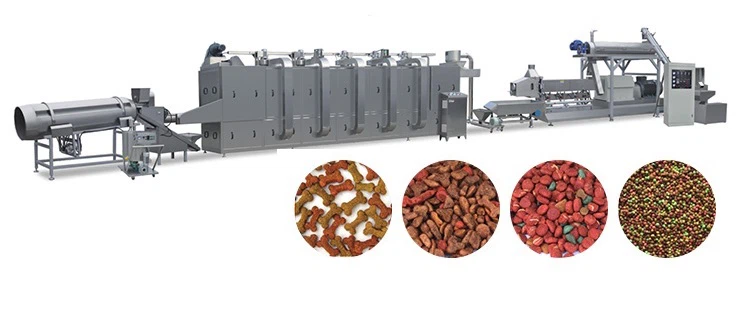
The pet food production line is a fully automatic production equipment for pet food such as cat food and dog food. It is mainly composed of raw material processing system, extrusion system, drying system, seasoning system and control system. The pet food production line has high stability and automation performance, and can control the expansion of the extrudate in a variety of ways. This ensures the texture of the final product. The equipment in the production line is usually all made of stainless steel to ensure low maintenance and hygiene. They can produce pet food in various shapes, such as triangle, steamed bun row, oval, bone shape, triangular plum blossom shape, square plum blossom shape, and square shape.
Features of Pet Food Production Lines
The automated control system will accurately control process parameters and automation to ensure pellet quality. The extrusion screw ensures uniform processing and positive pumping. The control system enables precise control of sinking and floating materials to obtain the proper degree of solidification and improve digestion and absorption rates.
Pet food formula, size, shape, and moisture content can be flexibly adjusted according to actual needs. This production line also allows users to add various powdery ingredients according to coloring and seasoning requirements.
Advanced crushing equipment can reasonably control the crushing fineness to suit the needs of pets while ensuring full utilization of raw materials.
The feeding system, extrusion system, and cutting system all use speed-regulating frequency converters, which ensures the stable operation of the entire production line.
Food contact surfaces are specially treated so they are very wear-resistant and easy to clean. Users do not need to spend a lot of cleaning time and cost when baking or changing materials.
Benefits of Pet Food Production Line
One of the main benefits of using a pet treats machinery line is the increased production capacity. With the use of automated machinery, you can produce a larger quantity of treats in a shorter amount of time. This not only increases efficiency but also allows you to meet the demands of your customers in a timely manner.
Another benefit of using a pet treats machinery line is the consistency in product quality. With manual production processes, there is always a risk of human error, which can result in inconsistencies in the final product. However, with automated machinery, you can ensure that each treat is made to the same specifications, resulting in a consistent product every time.
Using a pet treats machinery line can also help to reduce production costs. While the initial investment in machinery may seem high, the long-term benefits of increased efficiency and reduced labor costs can result in significant savings. This can help to increase profitability and allow you to invest in other areas of your business.
In addition to above benefits, using a pet treats machinery line can also help to improve food safety. With automated processes, there is less risk of contamination from human contact or improper handling. This can help to ensure that your products meet the necessary safety standards and regulations.
Pet Food Production Line Basic Production Process
Mix
The mixing process is a key process in pet food production. The basic process is to weigh raw materials of different weights according to the formula, and then pour them into the crusher for crushing. All raw materials are temporarily stored in the storage bin and then put into the blender to blend when ready.
Extrusion
Extrusion is a high-temperature, short-time heat treatment process. It not only reduces the degradation of food nutrients, but also improves the digestibility of protein and starch. Through different molds (templates) of the feed extruder, this production line can produce dry pet food in round, triangular, flower-shaped, bone-shaped and other shapes. To give pet food tablets different colors, pet food manufacturers often add pigmented water to the extrusion chamber.
Dry
The main function of drying is to remove moisture from puffed pet food. The freshly extruded material has a soft texture and a moisture content of 20-30%. After drying, the moisture content of the finished product can be controlled at 8% to 10%, making it easier to store.
Add Grease
Oil is the best source of energy. Depending on the pet's growth needs, 2%-40% oil can be added to the formula. We recommend that the fat content in the formula, i.e. the total oil content in the extruder, should be kept within 12%. If the oil content is required to exceed 12%, the hardness of the particles will be significantly reduced. The oil can be used under normal pressure or vacuum spraying, depending on the amount added. Spraying the outside with oil will give the pet food tablets a more attractive appearance. In addition to oil, some pet food manufacturers also spray some powdered attractants to increase the palatability of pet food.
Spray Coating
Adding fats and flavorings to kibble is important for making the food palatable for pets, but it’s also important to ensure that the pets get the right amount of fats, vitamins and minerals in their diet. Spray coating makes it easy to add liquid coatings to pellets. This process is both fast and efficient, so the pellets can move through the process quickly and get to packaging and then on to the customer and their pet.
Mist Coating
Mist coating takes liquid coating one step further, making it even easier and faster to apply liquid coatings to pellets. Mist coating equipment uses an atomizing system which turns liquid coatings into a fine mist, which evenly coats the material as it falls through the coating chamber. When comparing liquid coating systems, mist coating is one of the most efficient methods, since it provides more even coating, reduces waste, requires less clean-up, and tends to be gentler on the pellets, decreasing breakage and loss.
Cooling and Screening
The main function of cooling is to cool the dried materials from high temperature to close to room temperature and take away part of the moisture. During this process, the unqualified food tablets will be separated from the qualified food.
Package
The cooled pet food will be packaged in the packaging machine. The type of packaging can be designed and customized according to the customer's specific needs.
Pet Food Production Line Specifications
|
ITEM |
SPECIATION/PERFORMANCE |
|
|
Profile |
This processing line can produce pet food such as dog food, fish food, cat food etc in different sizes. Main Raw Material: wheat bran, bone powder, corn flour, fish powder, fresh meat etc |
|
|
Technical Parameter |
Please review the following: |
|
|
Capacity (Kg/Hr) |
150-200kg/h |
|
|
Mould |
Supply 6 sets of mould free of charge |
|
|
Voltage(V)/ |
380/50 |
If your industrial voltage/frequency is different from ours (380V, 50Hz, three phase), there will be an additional inverter charge for that line. |
|
Frequency(Hz) |
||
|
Dimension(Length*With*Height) |
20000x2500x3000mm or customized |
|
|
Workers No. |
3-4 |
|
Customized Options for Pet Food Production Lines
Pet Food Types
According to customer needs, our pet food production line can adapt to different kinds of raw materials, such as meat, grains, vegetables, etc. They allow for different principle processing options including cutting, grating, mixing, etc.
Extruder
According to the required particle size and shape, we can customize extruders of different specifications for customers to produce pet food that meets standards. We also offer a variety of forming mold options to make pet food in different shapes and sizes, such as bone, ball, etc.
Drying Equipment
According to the needs of different ingredients, we can adjust the baking temperature and time to ensure that the food maintains the ideal taste and nutritional value during the production process. We also provide a variety of drying methods, including hot air drying, vacuum drying, etc.
Packaging Equipment
We can provide different types of packaging equipment to meet different customers' business needs. These packaging machines allow users to customize labels to highlight product features and nutritional content.
Key Factors to Consider When Choosing a Pet Food Production Line
Pet food has always been in high demand in the market. If you are considering starting a pet food business, one of the most important decisions you will make is choosing the right machinery line. With so many options to choose from, you might not know where to start. The following content will explore the key factors to consider when selecting a pet food production line.
One of the most important factors to consider when choosing a pet food machinery line is production capacity. You want a machine that can produce enough treats to meet your demand without compromising on quality. The production capacity of a machinery line will depend on various factors such as the size of the machine, the type of treats you want to produce, and the speed of production.

Quality of Output
The quality of output is another crucial factor to consider when choosing a pet food production line. You want a machine that can produce high-quality treats consistently. The quality of output will depend on various factors such as the ingredients used, the design of the machine, and the expertise of the manufacturer.
Customization Options
If you're looking to create a unique brand of pet food, customization options are essential. You want a machinery line that can be customized to your specific needs, including the shape, size, and flavor of the food production. Customization options will depend on the manufacturer and the type of machinery line you choose.
Ease of Use and Maintenance
Another important factor to consider is the ease of use and maintenance of the machinery line. You want a machine that is easy to operate and maintain, with minimal downtime for repairs and maintenance. Look for a manufacturer that offers training and support to ensure that you can operate and maintain the machine effectively.
Cost
Cost is always a consideration when choosing a machinery line. You want to find a machine that offers good value for money without compromising on quality or features. Consider your budget and compare different machinery lines to find the best option for your needs.
5 Methods to Improve Pet Food Processing Safety
Here are five considerations that can help ensure that pet food processing facilities function in a safe, sanitary manner.
As in any food production facility, the layout should follow the production order, starting with raw ingredients and ending with the finished product. Following this order is critical because it minimizes the spread of bacteria and contamination to other parts of the facility. The right layout also creates a safer facility for employees and minimizes potential production mistakes.
Aside from producing great products, cleaning should be every facility’s number one priority. At the end of each day, employees should thoroughly clean the facility, from the lights to the floors. They should ensure that none of the surfaces have any food residue or lingering bacteria that can result in bacteria growth. Cleaning within the facility isn't limited to the surfaces you can see and use daily. The drainage system also requires thorough cleaning to ensure that no residual waste is left in the channel, where it can attract bugs and grow mold or other types of contamination. Even bacteria-resistant systems like Slot Drain need daily cleaning to maintain an adequately sanitized system.
Floor drainage is essential to keeping facilities clean, dry, and free from bacteria and contamination. For example, 70% of positive listeria screens are found in a facility’s drainage system, which shows just how critical it is to choose the correct type of drains.
Different ingredients require different methods of storage, and ensuring proper storage is essential in preventing bacterial growth. Everything should have designated storage space, in tightly sealed containers if necessary. Without tightly sealed storage, products can spoil or attract disease- and bacteria-carrying rodents and insects. Ingredients also need proper labels so that employees can properly identify and rotate product, keeping mistakes to a minimum and ensuring good first in, first out (FIFO) procedures are observed. Labels should include what an ingredient or product is and when it was produced in order to track the shelf life.Good labeling practices also help investigators track the source of contamination in the event that such measures are necessary.
Proper training is essential to ensuring that employees understand the production process and how to maintain a sanitary facility in order to prevent the spread of bacteria and contamination. By ensuring that employees have the proper training that is regularly reviewed and updated, facilities can function safely and efficiently. Training should cover everything about working in the facility, including handling and storing products, proper use of the various tools and equipment, proper personal hygiene, facility sanitation requirements, and much more. Proper training gives employees the tools to handle everything necessary to ensure food safety within a pet food processing facility.
Our Packaging
We will pack your machine as follows

Our Factory
This is a photo of our factory


Frequently Asked Questions
Q: How is pet food regulated?
Q: What is the profit margin in dog food business?
Q: Is pet food in high demand?
Q: Is making pet food profitable?
Q: Is pet food in short supply?
Q: Why is pet food so expensive?
Q: What are the problems with the pet food supply chain?
Q: What is the wet pet food production line?
Q: What is the difference between wet and dry pet food?
Q: What are the raw materials for pet food?
Q: How to manufacture pet food?
Q: How to start dog food business?
Q: Is there a track and trace system in the pet food production line?
Q: How big is pet food industry?
Q: What is the trend in pet food ingredients?
Q: What is the manufacturing process for dry pet food?
As one of the leading pet food production line manufacturers and suppliers in China, we warmly welcome you to buy durable pet food production line at competitive price from our factory. Good service and quality products are available.
