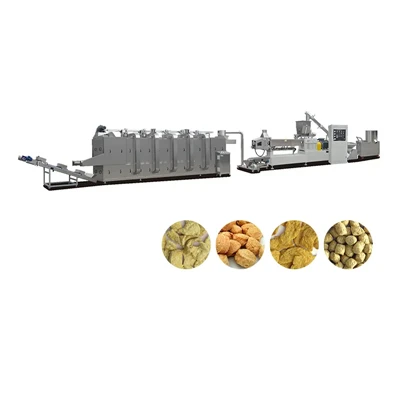
Complete Soy Protein Processing Line Description
This production line focuses on textured soy protein and soy protein isolate fiber products, using soybean meal and peanut meal as the main raw materials. Through grinding, stirring, conditioning, high temperature, high pressure, and high shear, the spherical protein molecules are unfolded into chains and reorganized to form a lamellar fibrous structure. Its products are highly nutritious, with the texture and taste of meat, free of cholesterol and animal fat, and feature oil-absorbing, water-absorbing, and flavor-absorbing properties, thus being widely used in various industries.

Complete Soy Protein Processing Line Principle
1. High efficiency and automation to improve production efficiency
The production line adopts an integrated process design, covering all links such as soybean cleaning, peeling, extraction, separation, purification, and drying. All equipment operates in coordination, reducing manual intervention and significantly shortening the production cycle. Equipped with an intelligent control system (such as PLC programming), it can accurately regulate parameters like temperature, pressure, and time to achieve continuous production. A single production line can handle several tons to dozens of tons per day, meeting the needs of large-scale production.
2. Precise processing to ensure product quality
Through multi-stage separation and purification technologies (such as centrifugal separation and membrane filtration), it can effectively remove impurities and anti-nutritional factors (e.g., trypsin inhibitors) from soybeans, improving the purity and functionality (such as solubility and emulsifying properties) of soy protein. The fully controllable processing environment (such as low-temperature deodorization and aseptic filling) can reduce protein denaturation, retain the natural nutrients of soy protein (such as amino acid composition), and ensure that the finished products meet various standards such as food grade and health product grade.
3. Resource recycling to reduce production costs
The production line can be equipped with a by-product recovery system. For example, soybean dregs separated during soybean processing can be used to produce feed, and soybean oil can be used as edible oil or industrial raw materials, realizing "one material with multiple functions" and improving raw material utilization. Energy-saving designs (such as waste heat recovery devices) can reduce the consumption of water, electricity, steam, and other energy sources. At the same time, through precise control of raw material input, waste is reduced, which can significantly lower the overall cost of enterprises in the long run.
4. Flexible adaptation to meet diverse needs
It can adjust process parameters according to customer requirements to produce different types of soy protein products, such as isolated soy protein, concentrated soy protein, and textured soy protein, adapting to applications in multiple fields including food, health products, and feed. The production line can be modularly combined, making it convenient for enterprises to upgrade or expand according to production capacity needs, reducing the cost and difficulty of equipment renewal.
5. In line with industry trends to facilitate sustainable development
As high-quality plant protein, soy protein conforms to the current consumption boom of "plant-based" food. The professional processing of the production line can promote the large-scale development of the plant protein industry, responding to the trends of healthy diet and environmental protection. Some advanced production lines adopt environmentally friendly processes (such as water-saving extraction technology and waste gas treatment systems) to reduce pollution during production, helping enterprises meet environmental regulations and enhance their social responsibility as a brand.

Main Equipment Introduction

Twin screw extruder

Screw & barrel of extruder

Cutting part of extruder

cooling system of extruder
Dryer
The dryer is a key piece of equipment added for moisture removal, which can effectively extend the shelf life of food.
Regarding the extension of food shelf life
Sterilization methods: Processes such as high-temperature sterilization, pasteurization, and irradiation sterilization can reduce the number of microorganisms in food. For example, canned foods that undergo high-temperature sterilization have a shelf life of up to 1-2 years because microorganisms are completely killed; while fresh foods that only undergo simple processing usually have a shelf life of only a few days. Packaging processes: Vacuum packaging and modified atmosphere packaging (such as nitrogen filling) can isolate oxygen, delaying oxidation and microbial contamination; sealed packaging can prevent external moisture and impurities from entering, resulting in a longer shelf life compared to bulk food. Adding preservatives: The rational use of food additives (such as sodium benzoate and potassium sorbate) can inhibit the reproduction of microorganisms and extend the shelf life, but it must comply with national food safety standards.

Food Characteristics
1. Unique Structural Organization and Processing Properties
2. Nutritional Value and Health Attributes
3. Wide Application Value and Cost-Effectiveness


Packing And Shipping
Company's After-Sales Service Commitments
1. Our after-sales service personnel can provide ingredient information and basic product formulas for related products.
2. On-site training will be provided to the buyer's relevant personnel on equipment operation and regular maintenance procedures.
3. Regular after-sales phone follow-ups will be conducted to help you solve any problems encountered during equipment use.
4. provide the buyer with high-quality and cost-effective spare parts all year round, and offer support for equipment upgrades and new product development, ensuring you have no worries.
5. For equipment damage occurring after the warranty period, after receiving the buyer's notification, our maintenance personnel will arrive at the site within 2 days for users within the province. For users outside the province, we will negotiate with technical personnel to reach the site as soon as possible. For out-of-warranty equipment, the company will charge service fees and costs for spare parts replacement.
6. During the warranty period, if equipment damage is caused by non-human factors, the company will provide free repairs. For equipment damage caused by human factors or force majeure, the company will provide repair services but charge relevant fees.

Company Introduction


Hot Tags: complete soy protein processing line, China complete soy protein processing line manufacturers, suppliers, factory, Textured Soy Protein Machine, Soy Isolated Protein Production Line, TSP Soya Protein Food Production Line, Vegetarian Soy Protein Making Machine, Textured Soya Protein Machine